

Messaging apps have become essential for businesses to communicate with customers quickly and efficiently. Among these, WhatsApp stands out as one of the most popular platforms globally, making it a key channel for customer support, marketing, and transactional notifications. However, leveraging WhatsApp effectively requires understanding its cost structure, which can significantly impact a company’s budget. This is where WhatsApp Business Cloud API Pricing becomes crucial.
The WhatsApp Business Cloud API offers a cloud-hosted solution that allows businesses to send messages at scale, integrate with CRMs, and manage multi-agent conversations without hosting infrastructure. Unlike the standard WhatsApp Business App, the Cloud API supports automated workflows, message templates, and advanced analytics, enabling companies to provide consistent and professional communication.
In this blog, we’ll explore the pricing models, key cost factors, recent updates, and step-by-step guidance on estimating your WhatsApp Business Cloud API Pricing effectively.
What Is WhatsApp Business Cloud API?
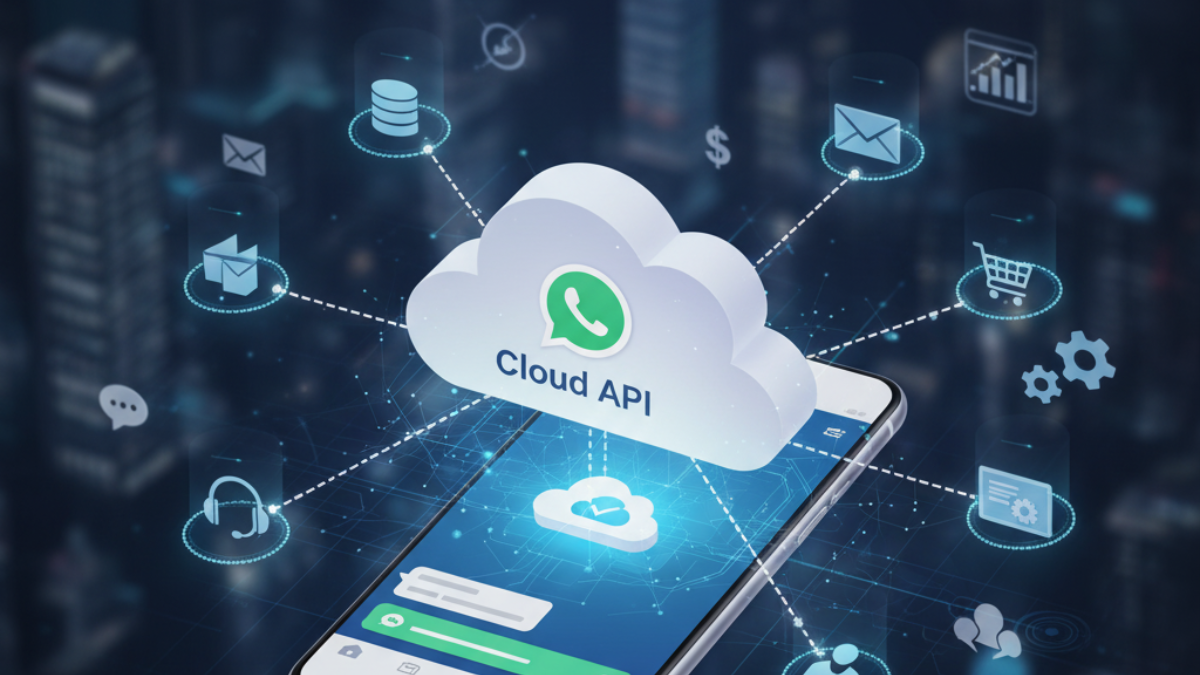
The WhatsApp Business Cloud API is Meta’s cloud-hosted solution designed for businesses that need scalable and secure messaging capabilities. According to Saysimple, the Cloud API allows companies to communicate with customers via WhatsApp while leveraging cloud infrastructure, eliminating the need for self-hosting.
Compared to the standard WhatsApp Business App, which is ideal for one-to-one messaging or small teams, the Cloud API supports multiple agents, integrates seamlessly with CRMs, and allows automated workflows through chatbots and templates. Businesses can centralize all customer communication in one platform, track conversation history, and gain insights into customer interactions.
Key benefits of the Cloud API include:
- Multi-user access: Multiple agents can manage conversations simultaneously.
- CRM integration: Connects with platforms like Salesforce, HubSpot, and custom CRMs.
- No hosting costs: Meta hosts the infrastructure, reducing IT overhead.
- Automation: Set up automated replies, chatbots, and message templates.
- Global reach: Reach customers in more than 180 countries.
- Analytics: Track response times, message status, and conversation metrics.
These advantages make understanding WhatsApp Business Cloud API Pricing essential for businesses planning scalable messaging solutions.
Pricing Models of WhatsApp Cloud API
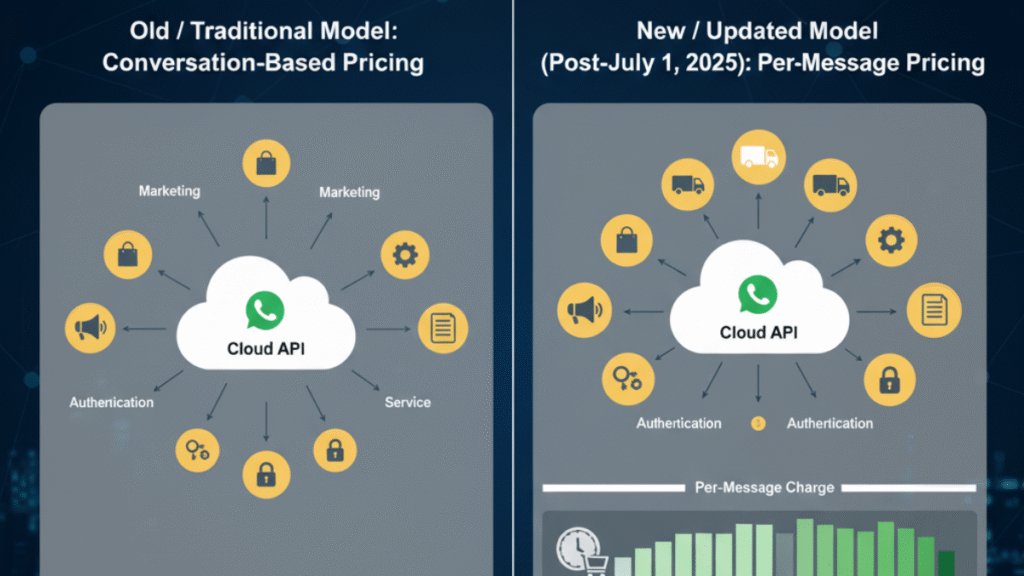
Understanding WhatsApp Business Cloud API Pricing requires knowing both the traditional conversation-based pricing and the updated per-message pricing model introduced in 2025.
There are two types of pricing models, as follows :
- Old/Traditional Model: Conversion-based pricing
- New / Updated Model: Per-message pricing
Old / Traditional Model: Conversation-Based Pricing
Previously, WhatsApp charged based on conversations. Each conversation had a 24-hour window, known as the customer care window, starting from the first message sent by the customer. All messages within these 24 hours were included in the same conversation and billed once.
Conversations were categorized as:
- Business-initiated: Messages sent by the company outside the 24-hour window.
- User-initiated: Messages sent by customers that opened a 24-hour window.
Businesses could benefit from a free tier, allowing the first 1,000 conversations per month at no cost. Beyond that, pricing depended on conversation category, marketing, utility, authentication, or service messages, each having distinct rates.
This model allowed predictable costs, particularly for companies with consistent messaging volumes.
New / Updated Model: Per-Message Pricing
Meta updated its pricing to a per-message model, charging for each message delivered. This model provides greater transparency but requires careful planning to control costs.
Message categories remain consistent:
- Marketing: Promotional campaigns or offers.
- Utility: Notifications like order updates or shipment tracking.
- Authentication: OTPs or verification messages.
- Service: Support or assistance messages.
The per-message rates vary by category, with authentication messages usually costing less and marketing messages higher. Volume-based discounts are available for businesses sending large volumes, reducing the per-message cost at higher tiers.
Additionally, Meta offers a 72-hour free entry-point window for messages originating from ads or CTA buttons, allowing businesses to engage customers without immediate charges. Understanding these changes is crucial for accurate WhatsApp Business Cloud API Pricing.
Key Cost Drivers/Factors That Influence WhatsApp API Pricing
Several factors influence WhatsApp Business Cloud API Pricing. Understanding these drivers helps businesses plan their messaging budgets effectively.
- Message Volume: Higher monthly volumes may unlock tiered pricing or volume discounts. Businesses sending thousands of messages must calculate the total cost carefully.
- Message Category: Marketing, utility, authentication, and service messages are priced differently. Choosing the correct category ensures accurate billing.
- Geographical Region: Meta’s rates vary by country. Some regions may have higher costs due to local telecommunications charges. Always check the latest rate card for your country.
- Template Usage: Messages sent outside the 24-hour window require approved templates, which come with specific charges. Efficient use of templates can reduce costs.
- Provider Markup: If using a Business Solution Provider (BSP) like Saysimple, their subscription fee is in addition to Meta charges. Some BSPs add platform fees for message management or multi-agent support.
- Support / Integration Costs: Integrating WhatsApp API with CRMs, setting up automation, or onboarding agents may involve additional costs.
- Number of Seats / Agents: Multi-agent inboxes or shared dashboards increase operational costs. Businesses must account for team size when budgeting.
By analyzing these factors, companies can forecast monthly expenses accurately and optimize usage for WhatsApp Business Cloud API Pricing.
How to Estimate Your WhatsApp Cloud API Costs
Estimating WhatsApp Business Cloud API Pricing requires a structured approach to understand potential monthly expenses. Here’s a step-by-step guide:
- Estimate Monthly Message Volume: Forecast the total messages your business expects to send and receive each month, including customer inquiries, notifications, and marketing campaigns.
- Break Down by Message Category: Classify messages into marketing, utility, authentication, and service categories. Each category has different rates, and categorization ensures accurate cost estimation.
- Check Regional Rates: Meta’s per-message rates differ by country. Access the official Meta rate card to determine precise charges for your target market.
- Factor in Free Windows: Leverage the 72-hour free entry-point window for messages originating from ads or CTA buttons. These interactions do not incur charges, reducing total monthly expenditure.
- Include BSP or Platform Costs: If using a Business Solution Provider like Saysimple, add their subscription or platform fees. Keep in mind that template message charges are separate from BSP fees.
- Sample Calculation: For example, consider a business sending 50,000 template messages (business-initiated), 10,000 service replies (user-initiated), and 5,000 authentication messages. Assuming standard Meta rates and using the free 72-hour window efficiently, the total monthly cost can be estimated by summing per-message charges, BSP fees, and any additional integration costs.
This approach ensures businesses can plan their budgets with precision and optimize WhatsApp Business Cloud API Pricing according to volume and message type.
Real-World Examples/Use Cases
Understanding pricing becomes clearer when we examine how businesses use WhatsApp Cloud API in real-world scenarios.
E-commerce for Order Updates (Utility Messages): A mid-sized online retailer uses the Cloud API to send order confirmations, shipping updates, and delivery notifications. By categorizing these as utility messages, the company benefits from lower per-message rates and reduces customer support workload.
Marketing Campaigns: A clothing brand runs promotional campaigns via WhatsApp, sending marketing messages to segmented customer lists. Here, higher per-message rates apply, making it essential to plan campaigns strategically to avoid overspending.
Customer Service (Service Messages): A telecom company manages customer inquiries through multi-agent inboxes. User-initiated messages open a 24-hour service window, allowing businesses to respond without additional template charges.
Cost Comparison: Small vs. Large Enterprise:
- A small business sending 5,000 monthly messages may spend only a few hundred dollars, especially if leveraging free windows and focusing on utility messages.
- A large enterprise sending over 100,000 messages across marketing, utility, and authentication categories could incur thousands of dollars monthly, highlighting the importance of accurate forecasting and the possible use of volume-based discounts.
These examples illustrate how different messaging types and volumes impact WhatsApp Business Cloud API Pricing, emphasizing strategic planning for cost efficiency.
Conclusion
Understanding WhatsApp Business Cloud API Pricing is essential for businesses aiming to leverage WhatsApp as a scalable communication channel. The shift from conversation-based to per-message pricing in 2025 provides greater transparency but also requires careful planning to optimize costs. By considering key factors such as message volume, category, regional rates, template usage, and potential BSP fees, companies can accurately forecast monthly expenses and prevent budget overruns. Real-world use cases, ranging from e-commerce order updates to marketing campaigns and customer service, illustrate how varying message types and volumes affect costs. Utilizing free windows effectively, categorizing messages correctly, and taking advantage of volume-based discounts can significantly enhance cost efficiency.
Ultimately, businesses that invest time in understanding these pricing structures can maximize the benefits of the WhatsApp Business Cloud API, delivering timely, automated, and professional communication to customers while maintaining control over messaging expenditures. Strategic planning ensures WhatsApp remains a powerful and cost-effective. A tool for customer engagement.

Leave a Reply