Modern business often feels like navigating a huge maze of connected projects. Each project carries its own deadlines, risks, and expectations. Teams move fast, but the work becomes harder to track as everything grows. Without structure, even strong teams struggle to stay aligned. Important details get lost in the rush. Small delays start to pile up. The overall picture becomes harder to see. This is why the right program management software matters so much today. It brings all moving parts into one clear place. It helps teams stay organized, informed, and connected. With a proper system, leaders gain the visibility they need. Projects stay on track.
Program management software is the platform that ties everything together. It unifies your environment by allowing you to plan, track, govern, and align multiple related projects with strategic goals. While project management focuses on delivering a single defined outcome, program management zooms out to oversee clusters of interconnected projects, ensuring they collectively deliver long-term business value.
In this guide, you’ll learn not just what program management software is, but how to select the ideal solution for your organization’s evolving needs. By the end, you’ll have a clear, practical understanding of the leading tools and which one may serve as your strongest strategic advantage moving forward.
Why Effective Program Oversight Is Your Strategic Compass
Guiding a modern organization without proper program oversight is like steering a ship through unpredictable seas with only a dim lantern for direction. Clear visibility, structured coordination, and strategic alignment are the lighthouse beams that keep your initiatives moving toward meaningful outcomes. That is precisely why a strong program management platform becomes an executive’s compass offering clarity where complexity once dominated.
Key Benefits of a Good Management Software
- Aligning Work with Business Strategy
Ensures every project contributes to larger organizational objectives. - Optimizing Resource Allocation
Helps distribute skills, time, and budgets where they deliver the highest value. - Proactive Risk and Dependency Management
Identifies potential issues before they halt progress across multiple teams. - Enhanced Visibility and Reporting
Offers dashboards and real-time insights necessary for informed decisions. - Streamlining Governance and Compliance
Improves consistency, documentation, and control across all initiatives.
Practical Guide While Choosing Best Program Management Software
Selecting the right software is not just a choice, it’s a strategic move that influences how effectively your organization can oversee large initiatives. The right platform becomes the structural backbone of your governance model, ensuring collaboration, alignment, and clarity across teams and stakeholders.
1. Scalability and Flexibility
Your software should evolve with your organization. As programs expand, it must accommodate new teams, workflows, and priorities without friction.
2. Integration with Existing Systems (Crucial for a Connected Enterprise)
A strong platform integrates smoothly with CRMs, ERPs, communication apps, and analytics tools, ensuring continuity across your digital ecosystem.
3. Reporting and Analytics Power
Comprehensive dashboards, automated reporting, and predictive insights help leaders stay ahead of risks and make data-driven decisions.
4. User Experience and Adoption Rate
Adoption determines success. The interface should be intuitive, visually clean, and designed to support daily collaboration.
5 Support for Multiple Methodologies (Agile, Waterfall, Hybrid)
Programs rarely follow one delivery model. The best program management software supports diverse methodologies while keeping everything aligned at the strategic level.
Top Contenders for the Best Program Management Software
Planview — Enterprise-Grade Program & Portfolio Visibility
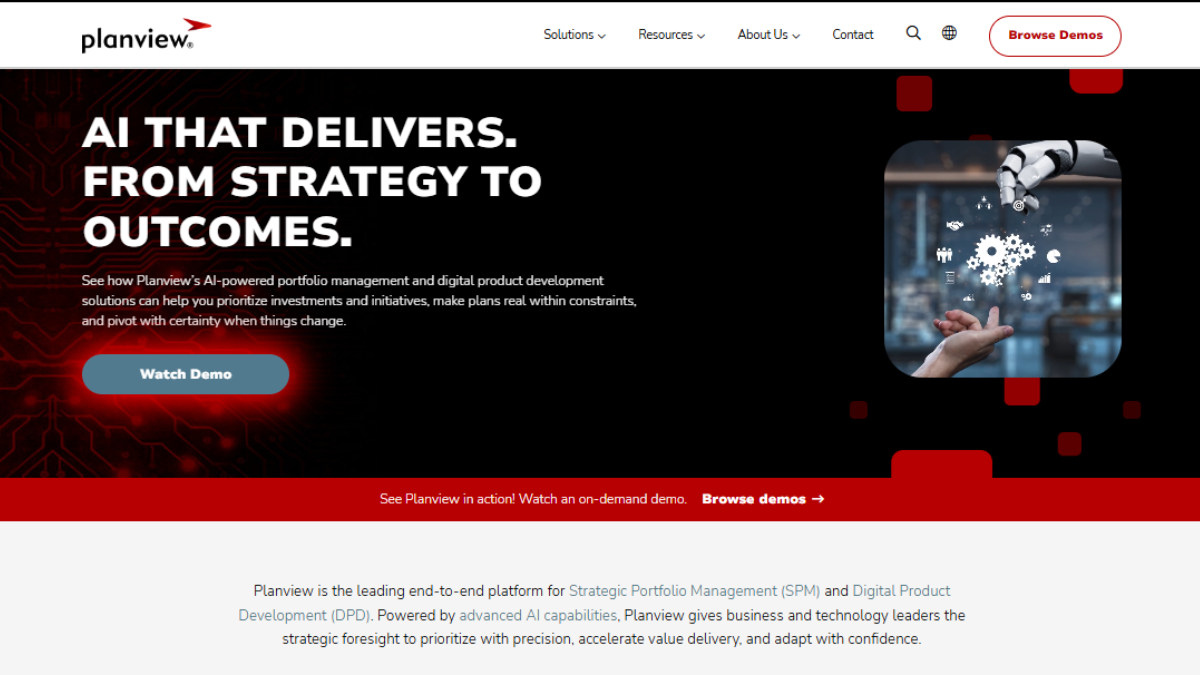
Planview is a leading choice for enterprises that need end-to-end visibility across portfolios, resources, risks, and strategic goals. It goes far beyond basic program tracking by offering a unified platform where leaders can connect planning with execution in a seamless, data-driven environment. Because of its depth, Planview is especially well-suited for organizations handling large, multi-layered initiatives that require tight coordination between teams, projects, and long-term business outcomes.
One of the biggest advantages of Planview is how it transforms complexity into clarity. With real-time dashboards, scenario planning, predictive forecasting, and enterprise-wide resource capacity insights, it allows decision-makers to understand not just what’s happening now, but what will happen next when priorities shift. This empowers leaders to adjust workloads, prevent bottlenecks, and ensure the right teams are aligned with the right strategic goals.
💡Pro Tip
Use scenario planning to compare multiple portfolio outcomes before allocating resources. It helps you choose the most ROI-focused approach.
Microsoft Project — Enterprise Scalability and Integration
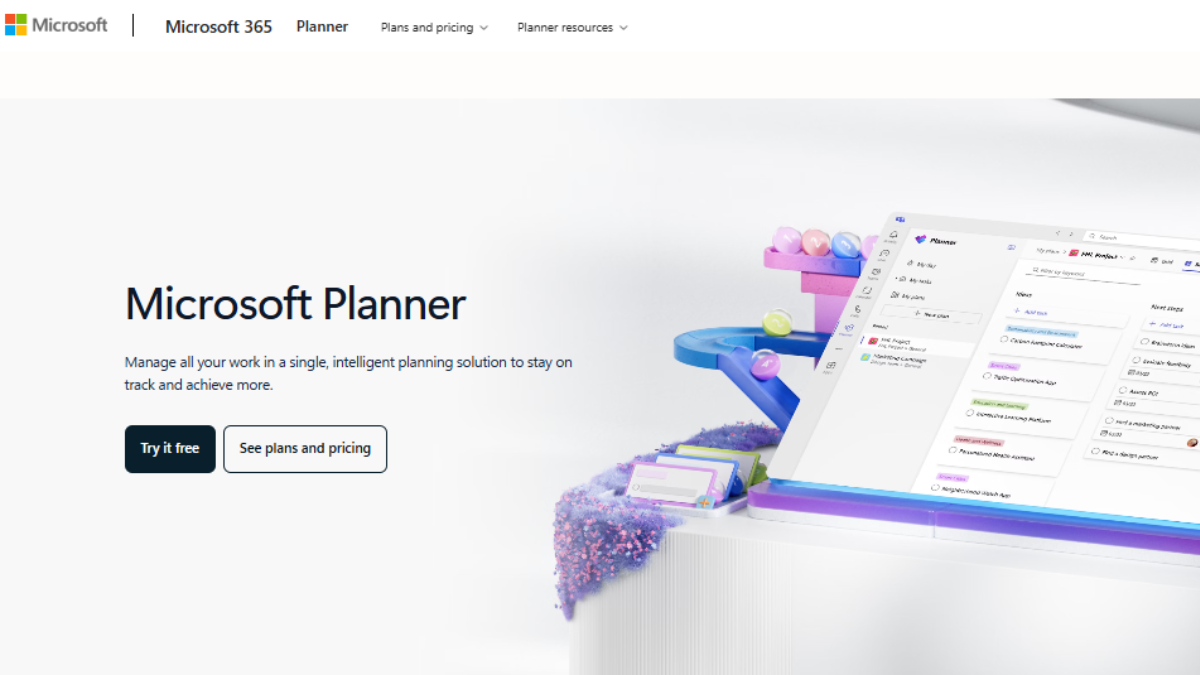
Microsoft Project is a powerful enterprise-grade solution that fits naturally into the Microsoft 365 ecosystem, making it a preferred choice for organizations that rely heavily on Microsoft tools. Its tight integration with Teams, SharePoint, Power BI, and Planner helps centralize communication, documentation, reporting, and collaboration ensuring every project stays connected across departments and stakeholders.
Unlike many tools that focus solely on one delivery approach, Microsoft Project supports traditional waterfall planning, Agile workflows, and hybrid models, making it adaptable for modern enterprises with diverse teams. Its structured environment helps organizations streamline scheduling, manage cross-functional dependencies, track resource loads, and maintain strategic alignment across large-scale programs.
One of the biggest strengths of Microsoft Project is its emphasis on precision and governance. Enterprises gain a highly controlled workspace backed by strong reporting models, Gantt visibility, and dependency mapping. Paired with Power BI dashboards, leaders can access real-time insights for forecasting, risk management, and performance tracking, helping programs stay on budget, on schedule, and aligned with corporate objectives.
💡Pro Tip
Use Microsoft Project alongside Power BI to create unified, drill-down dashboards that replace manual reporting—this not only strengthens governance but also gives leadership real-time visibility into schedule risks, resource bottlenecks, and program-wide performance.
BrightWork 365 — SharePoint and Microsoft 365 Harmony
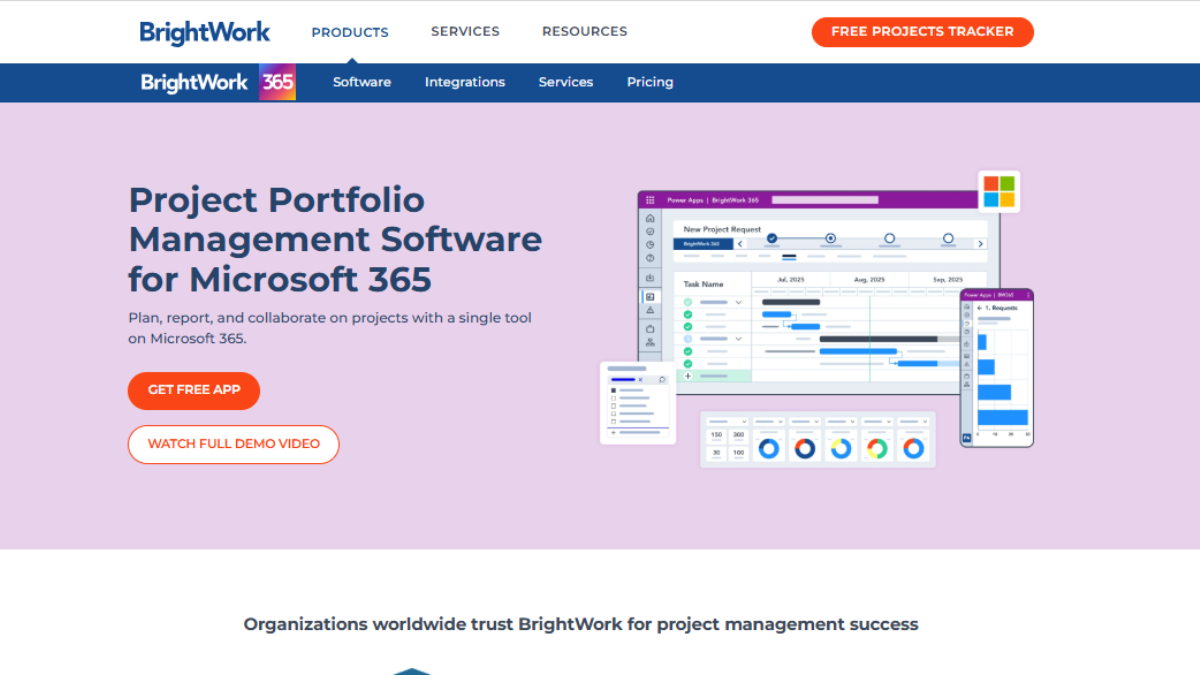
BrightWork 365 is designed specifically for Microsoft-driven organizations that want a structured, scalable, and governance-friendly project management environment without long implementation cycles. Built on Microsoft 365 and fully aligned with SharePoint and Teams, it gives enterprises a familiar, secure, and tightly integrated ecosystem to run programs and portfolios.
Where many tools require complex configuration to get started, BrightWork 365 speeds up the entire process with pre-built project and program templates. These templates standardize delivery, reduce setup time, and ensure every team follows the same methodology. This consistency is invaluable for organizations that need governance, compliance, and audit-worthy tracking.
The platform also excels in visibility. Automated reporting, centralized dashboards, and project health indicators give stakeholders a clear snapshot of risks, progress, and alignment across multiple initiatives. Teams benefit from structured workflows, while leadership gains clarity and control over program execution—all without needing heavy customization or third-party add-ons.
💡 Pro Tip
Take advantage of BrightWork 365’s pre-built program templates as your governance baseline then refine them gradually based on performance data from project health reports to create a consistent, audit-ready delivery framework across the organization.
Genius Project (Cerri Project) — A Software for Complex Programs

Cerri Project is built for enterprises that require strict oversight, compliance, and control across every stage of the program lifecycle. Its architecture is designed for industries where accuracy, traceability, and risk management are non-negotiable such as manufacturing, engineering, healthcare, government, and other regulated environments.
Unlike lightweight project tools, Cerri Project excels in high-governance scenarios by offering detailed financial tracking, resource forecasting, and advanced risk modeling. This allows organizations to evaluate scenarios before committing resources, manage long-term capacity, and maintain transparency across portfolios.
The platform also supports rigorous documentation and audit-ready workflows, ensuring every decision, approval, and change is properly recorded. Its structured environment helps teams maintain compliance while enabling leaders to monitor program performance, predict risks, and align initiatives with strategic business goals. Cerri Project ultimately gives enterprises the accuracy and operational discipline required to manage complex, multi-layered program environments without losing visibility or control.
💡Pro Tip
Use Cerri Project’s forecasting and risk modeling together to simulate multiple program outcomes. This helps you identify vulnerabilities early and make informed decisions that keep long-term initiatives compliant, predictable, and resource-efficient.
UNICOM Focal Point — Strategic Portfolio and Product Alignment

UNICOM Focal Point is built for organizations that need a disciplined, data-driven way to select the right initiatives, not just more of them. The platform helps enterprises evaluate projects, products, and investments based on strategic importance, customer expectations, potential ROI, and overall business impact. This makes it especially valuable for product-centric companies that depend on accurate prioritization to stay competitive.
What sets Focal Point apart is its structured decision-making environment. Leaders can compare initiatives using customizable scoring models, weigh trade-offs, and ensure every investment aligns with long-term goals. With its centralized visibility, teams can avoid subjective decisions and instead focus on objective criteria that highlight true strategic value.
The software also promotes alignment across departments by offering transparent evaluation tools, scenario comparisons, and executive-level dashboards. This helps product teams, PMOs, and leadership maintain clarity on which initiatives matter most and why while ensuring resources are allocated to efforts with the highest business return.
💡Pro Tip
Create multiple scoring models for different initiative types (products, enhancements, innovation projects) so each one is evaluated fairly. This increases prioritization accuracy and reduces bias in executive decision-making.
Epicflow — Multi-Project Capacity and Resource Optimization
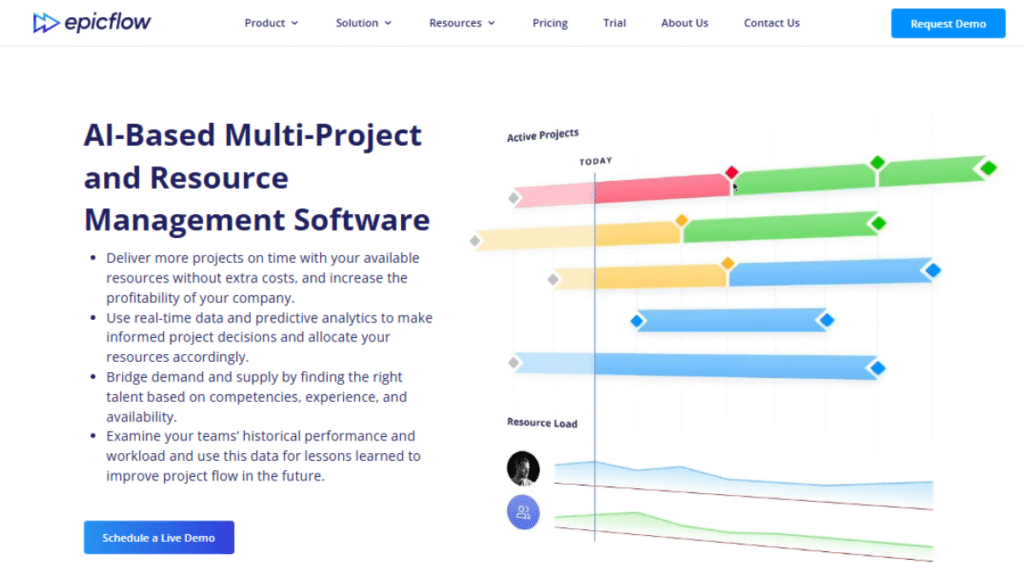
Epicflow is built for organizations handling multiple projects simultaneously, especially those that struggle with shared resources, conflicting priorities, and unexpected schedule shifts. The platform uses advanced predictive algorithms to monitor resource load, forecast conflicts, and automatically identify bottlenecks before they escalate. This proactive visibility allows teams to stay ahead of delays rather than reacting to them too late.
A key strength of Epicflow is its dynamic scheduling engine, which continuously recalculates task priorities based on real-time changes. Instead of rigid plans, teams benefit from fluid, adaptive workflows that respond to new dependencies, incoming work, or shifting resource capacities. This makes it particularly valuable for environments such as engineering, product development, manufacturing, and IT anywhere multiple streams of work compete for the same expertise.
Epicflow also centralizes resource capacity insights, making it easier for leaders to assign work intelligently, balance workloads, and prevent burnout. Teams gain clarity into which tasks matter most at any given moment, while executives receive a unified picture of how every project impacts the overall portfolio. The result is smoother execution, fewer overloads, and more predictable delivery across all initiatives.
💡Pro Tip
Use Epicflow’s predictive load analysis weekly to rebalance resources before overloads occur making small adjustments early prevents major timeline disruptions across the entire project portfolio.
Comparison Table
| Software | Best For | Key Strengths | Methodology Support | Ideal Team Size |
| Planview | Enterprise portfolio & resource visibility | Strategy alignment, forecasting, deep portfolio governance | Agile, Waterfall, Hybrid | Medium–Large enterprises |
| Microsoft Project | Microsoft 365 organizations | Power BI reporting, scheduling depth, ecosystem integration | Agile, Waterfall, Hybrid | All sizes (best for mid–large) |
| BrightWork 365 | SharePoint/M365-first teams | Templates, health indicators, structured workflows | Waterfall, Hybrid | Small–Medium businesses |
| Genius Project (Cerri Project) | Governance-heavy & regulated environments | Financial tracking, compliance, full lifecycle management | Waterfall, Hybrid | Medium–Large enterprises |
| UNICOM Focal Point | Strategic product & portfolio alignment | Prioritization, investment analysis, market-driven decisions | Top-down strategic frameworks | Mid–Large product teams |
| Epicflow | Multi-project & resource-intensive environments | Predictive resource loading, bottleneck detection | Flexible, Multi-project | Teams with shared resources |
Conclusion
Choosing the best program management software is a strategic investment that determines how efficiently your organization can manage complex initiatives, align teams, and deliver consistent results. The tools listed above each shine in different environments; some excel in strategic portfolio alignment, while others focus on resource optimization, governance, or enterprise-level integration.
To make the best choice, evaluate your needs around visibility, collaboration, methodology, governance style, and long-term scalability. With the right platform in place, your teams gain clarity, leaders gain confidence, and your organization gains the structure needed to deliver consistently at scale.