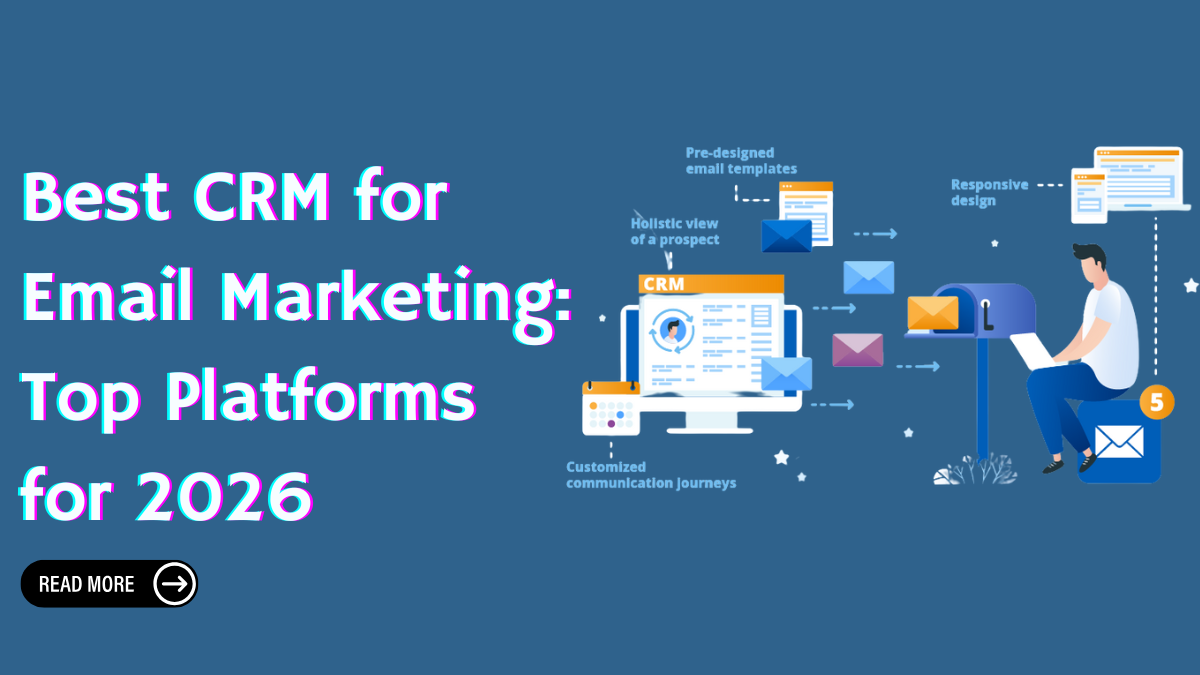
Choosing the best CRM for email marketing can make a significant difference in how businesses manage customer relationships and run effective campaigns. A CRM, or Customer Relationship Management system, centralizes contact information, tracks customer interactions, and provides actionable insights. When combined with email marketing tools, it allows businesses to send personalized, targeted messages to specific audience segments, automate follow-ups, and monitor campaign performance in real-time. Today, companies rely heavily on CRM-driven email campaigns to nurture leads, boost engagement, and increase conversions. With countless CRM options available, selecting the right platform can feel overwhelming. Businesses need a solution that balances usability, automation, analytics, and integration capabilities.
In this guide, we’ll highlight key features to look for, explore the benefits of CRM-powered email marketing, and provide tips to help you choose the right CRM for your business. We’ve also listed the best crm tools for email marketing that you can choose from. By leveraging the right tools, you can streamline communication, improve customer relationships, and achieve better marketing results.
What Is a CRM for Email Marketing?
A CRM for email marketing is an all-in-one platform that brings customer relationship management features together with built-in email marketing tools. Instead of relying on separate systems to store customer data and run email campaigns, this unified approach allows businesses to manage contacts, track interactions, and send targeted emails from a single dashboard.
Using the best CRM for email marketing helps streamline workflows by keeping customer information, segmentation, automation, and campaign performance data in one place. This makes it easier to create personalized email campaigns, monitor engagement, and build stronger relationships with your audience. By centralizing data and communication, businesses can save time, improve consistency, and make more informed marketing decisions.
Who Needs a CRM for Email Marketing?
If you’re running email campaigns through one platform while storing customer information in another, you’re likely adding extra effort to your workflow and overlooking valuable data insights. A CRM for email marketing is especially useful for:
- Sales teams that want visibility into email interactions and the ability to automate timely follow-ups
- Marketing teams focused on nurturing leads through personalized and behavior-driven email sequences
- Small to mid-sized businesses looking to simplify their tech stack and reduce reliance on multiple tools
- Organizations aiming to improve alignment between sales and marketing teams through shared data and communication
In short, a CRM for email marketing acts as a centralized hub for managing customer relationships and email outreach. By unifying data and communication in one system, teams can work more efficiently and run more impactful, data-driven campaigns.
8 Best CRM for Email Marketing
1. HubSpot CRM
HubSpot is widely considered one of the best CRM for email marketing because it unifies sales, marketing, and customer service under one platform. Its intuitive CRM dashboard makes contact management seamless, enabling you to segment audiences, send personalized emails, and track engagement easily. HubSpot’s email marketing tools are integrated with its workflows, allowing automated follow-ups, A/B testing, and detailed performance analytics. The drag-and-drop email builder helps you design professional campaigns without coding skills. HubSpot also offers smart content features that personalize messages based on contact behavior and lifecycle stage. Reporting tools let you monitor open rates, click-through rates, and campaign ROI in real time.
Additionally, HubSpot’s free tier provides essential CRM and email marketing features, making it ideal for startups and growing businesses. As your business scales, its advanced automation and segmentation tools make managing complex campaigns easier. For those seeking a powerful, scalable solution, HubSpot consistently ranks among the top.
2. Salesforce CRM
Salesforce is a market-leading platform often recommended as the best CRM for email marketing for enterprises and mid-sized companies that need customizability and power. With its robust suite of tools, Salesforce combines CRM, marketing automation, and analytics to deliver targeted email campaigns at scale. Its Marketing Cloud includes Journey Builder for creating customer-centric automation flows and Einstein AI for predictive insights. Salesforce enables deep segmentation through dynamic lists and custom fields, so email campaigns align with specific audience behaviors. Advanced reporting gives teams a detailed understanding of campaign performance and customer engagement. While implementation can be complex,
Salesforce’s flexibility makes it suitable for businesses with intricate sales processes and large databases. Integration options with third-party apps further expand functionality. For organizations with dedicated marketing teams and technical resources, Salesforce remains a top choice. Its comprehensive ecosystem ensures that CRM and email marketing work harmoniously toward engaging customers at every stage of the buyer journey.
3. Zoho CRM
Zoho CRM is a strong contender for the best CRM for email marketing, especially for small to mid-sized businesses. It merges contact management with automated email campaigns, lead scoring, and real-time analytics. Zoho lets you create custom email templates, schedule mailers, and track responses directly within the CRM. Its built-in workflows enable automated follow-ups and trigger emails based on specific actions, reducing manual effort. Zoho’s drag-and-drop email builder is user-friendly, making campaign creation accessible even if you lack technical expertise. You can segment lists using detailed filters based on demographics, behavior, and engagement history. Reporting dashboards offer insights into open rates, click rates, and conversion metrics, helping you refine strategies.
Zoho integrates seamlessly with other productivity tools like Zoho Campaigns and third-party apps such as Mailchimp and Google Workspace. Its affordable pricing and scalable features make it a great choice for businesses seeking a full-featured yet budget-friendly CRM. For companies focused on email-driven growth, Zoho balances power and simplicity.
4. Mailchimp CRM
Mailchimp is often thought of as an email marketing tool, but it has evolved into a CRM platform that ranks among the best CRM for email marketing for small businesses and solopreneurs. It combines audience management, email automation, and detailed reporting in one place. Mailchimp’s CRM features help you organize contacts, track customer interactions, and segment audiences for targeted campaigns. Its easy-to-use interface and template library make designing professional emails fast and simple. Advanced automations such as welcome series, abandoned cart emails, and behavioral triggers ensure timely, personalized communication.
Mailchimp also offers predictive insights like purchase probability and segmentation suggestions to improve engagement. Analytics dashboards help you monitor campaign performance with clear visual reports on opens, clicks, and subscriber growth. Integration with e-commerce platforms like Shopify and WooCommerce further enhances its marketing capabilities. While Mailchimp may not offer the enterprise-level depth of some CRMs, it’s an excellent choice for small teams focused on email engagement and conversion. Its combination of CRM and email features earns it a spot on this list.
5. ActiveCampaign

ActiveCampaign is widely regarded as one of the best CRM for email marketing due to its powerful automation and CRM capabilities tailored to both small businesses and growing enterprises. It combines advanced segmentation, powerful email automation, and integrated sales CRM tools in one platform. ActiveCampaign’s automation builder allows you to create complex workflows that respond to customer behaviors, ensuring timely and personalized email delivery. Lead scoring and tagging help prioritize high-value contacts, improving sales follow-up. Its email templates and split-testing features make optimizing campaigns easier. Reporting tools provide deep insights into campaign performance, revenue attribution, and audience engagement.
ActiveCampaign’s CRM integrates directly with the email tools, so sales and marketing teams can work from a unified customer profile. Additionally, dynamic content makes it possible to tailor messages to different contact segments without creating separate campaigns. The platform supports integrations with popular apps like Shopify, WordPress, and Salesforce. For businesses that want advanced automation and CRM synergy, ActiveCampaign offers a compelling, scalable solution.
6. Pipedrive CRM

Pipedrive may not be the first name that comes to mind for email-focused marketing, but it’s one of the best CRM for email marketing when paired with its automation and tracking features. Pipedrive’s easy-to-use interface helps teams visualize the sales pipeline while managing contacts effectively. Its email integration allows you to send, receive, and track emails directly within the CRM. You can create custom templates, set up automated follow-ups, and schedule send times to match audience behavior.
Pipedrive’s workflow automation reduces repetitive tasks, ensuring leads receive consistent, timely communication. It also provides engagement insights like open rates and response metrics tied back to individual deals and contacts. Through integration with tools like Mailchimp and Zapier, Pipedrive can extend its email marketing capabilities further. Its simplicity and focus on sales make it ideal for teams that want CRM-first functionality with essential email marketing features. For businesses prioritizing pipeline management with integrated email workflows, Pipedrive is a valuable choice on this list.
7. Sendinblue CRM
Sendinblue stands out as one of the best CRM for email marketing thanks to its blend of powerful automation, multichannel messaging, and a built-in CRM that centralizes customer data. Designed for marketers who want all communication in one platform, Sendinblue enables email, SMS, and chat campaigns. You can build responsive email templates, implement automated workflows, and segment contacts using various filters. Its CRM module helps track leads, manage deals, and store customer interactions, providing context for personalized messaging. Advanced features like send-time optimization and A/B testing help improve campaign effectiveness. Reporting dashboards give insights into delivery rates, clicks, and conversions. Unlike platforms that require separate tools for email and CRM, Sendinblue’s unified approach simplifies campaign management.
Integration with e-commerce platforms and third-party apps further enhances functionality. For businesses focused on multichannel engagement with strong CRM support, Sendinblue offers excellent value. Its combination of features, affordability, and ease-of-use make it a standout choice.
8. Keap (formerly Infusionsoft)
Keap is designed for small businesses and entrepreneurs looking for one of the best CRM for email marketing solutions that also automates sales and marketing processes. It brings CRM, email marketing, and powerful automation into a single platform. Keap’s email tools help you create personalized campaigns, set up automated follow-ups, and track engagement metrics with ease. Its CRM centralizes all contact information, purchase history, and interaction data, enabling highly targeted messaging. With lead capture tools, appointment scheduling, and payment options built-in, Keap helps streamline the customer lifecycle from lead to sale. Automation sequences can be triggered based on behavior, ensuring timely communication without manual intervention. Reporting dashboards provide insights into campaign performance, revenue tracking, and sales activities.
While Keap’s learning curve can be steeper than some others on this list, its robust automation and CRM capabilities make it ideal for businesses seeking growth without juggling multiple tools. For those focused on automation-rich email marketing and customer management, Keap delivers strong results.
Tips for Choosing the Right CRM
Selecting the right CRM for email marketing involves careful consideration:
- Assess Business Needs – Determine the level of automation and reporting required.
- Consider Audience Size – Choose a platform that can scale with your contact list.
- Evaluate Usability – Ensure the interface is user-friendly for your team.
- Check Integrations – Verify compatibility with your existing marketing and sales tools.
- Budget – Compare pricing tiers and select a CRM that fits your financial plan.
- Customer Support – Reliable support ensures smoother onboarding and problem resolution.
Following these tips will help you select a CRM that aligns with your business goals and marketing strategy. By leveraging these benefits, businesses can maximize the impact of their email marketing campaigns while maintaining stronger connections with their audience.
Conclusion
Selecting the right CRM can significantly enhance the effectiveness of your email marketing campaigns. By leveraging automation, segmentation, personalization, and analytics, businesses can streamline communication, nurture leads, and improve overall customer engagement. A robust CRM ensures that all customer interactions are centralized, making it easier to track behavior, optimize campaigns, and measure ROI. Integration with other tools and channels further strengthens your marketing strategy, allowing for a seamless experience across email, social media, and e-commerce platforms. While each business has unique needs, focusing on usability, scalability, and support will help you choose the platform that best aligns with your goals.
Whether you are a small startup or a large enterprise, investing in the best CRM for email marketing allows you to save time, increase conversions, and build long-lasting customer relationships. A carefully selected CRM can truly transform your email marketing into a strategic growth driver.