AI tools simplify complex research tasks by extracting structured insights from unorganized data, identifying patterns, and turning raw information into meaningful conclusions. The Best AI Tools for Research can automate time-consuming processes such as literature reviews, data sorting, reference management, and document comparison, saving researchers valuable hours. These intelligent platforms also reduce human error, ensuring higher accuracy in analysis and interpretation. As artificial intelligence continues to evolve, its ability to process vast datasets, create concise summaries, and support data-driven decision-making becomes even more essential. For modern researchers looking to stay ahead, the AI Tools for Research along with the best AI productivity apps offer unmatched efficiency, clarity, and precision, ultimately elevating the quality and impact of research outcomes across academic, scientific, and business domains.
Whether you’re a student, academic professional, analyst, or entrepreneur, the integration of AI into research workflows offers a new level of convenience and accuracy. AI-powered platforms can read dense PDFs, map citations, generate summaries, and uncover relationships between sources that would take hours to detect manually. These innovations enhance productivity and enable researchers to invest more time in analysis rather than repetitive tasks. With intelligent recommendations, advanced communication features, and cloud-based technology, AI becomes a reliable companion in research excellence. As more industries embrace these tools, the research landscape continues to shift, opening opportunities for faster, more informed discovery.
What Makes an AI Tool Good for Research?
AI research tools must combine accuracy, automation, and usability to truly enhance productivity. A great tool should analyze large volumes of content, interpret insights, and present findings in a simplified manner. Tools capable of extracting information from PDFs, academic papers, datasets, and online sources are especially valuable. When evaluating the best ai tools for research, users should also consider transparency, data handling, and efficiency. An AI system must be able to cite or verify information, maintain context, and ensure reliability.
Along with automation, a strong AI tool should offer seamless integration into existing workflows. Features like note-taking, summarization, and real-time collaboration greatly improve research capabilities. AI tools that deliver structured insights, highlight important points, and support multi-source imports help streamline the process. Whether performing literature reviews or conducting market research, ideal AI platforms must be intuitive, customizable, and able to scale with user needs. This combination ensures better outcomes and a smoother experience for researchers across all fields.
5+ Best AI Tools for Research
The Best AI Tools for Research help simplify complex tasks, improve data accuracy, and speed up analysis. These tools assist in summarizing papers, organizing information, and generating insights quickly, making them essential for students, professionals, and researchers aiming for efficient, high quality results.
1. Scite.ai
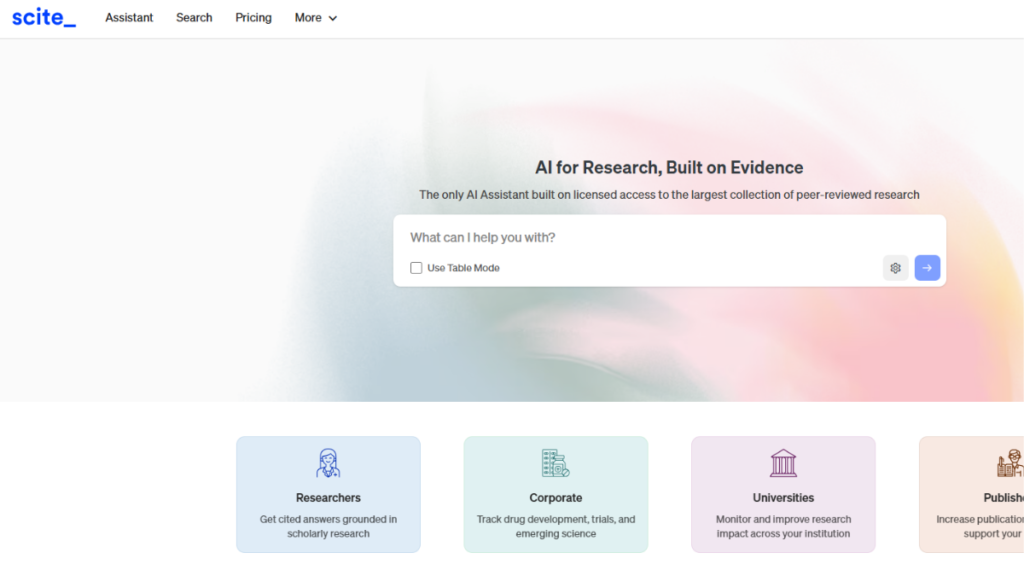
Scite.ai is a powerful platform designed to improve academic research by validating citations and evaluating the credibility of scientific papers. It identifies whether a citation supports, contradicts, or merely mentions a claim, helping researchers assess accuracy instantly. Scite.ai streamlines the evaluation process by providing structured citation charts and deep insights into research trends. With smart filtering options, users can explore papers, authors, and journals more effectively. The platform is widely used in universities and scientific institutions for quality verification and literature analysis. It is one of the Best AI Tools for Research when accuracy is essential.
Key Features:
- Scite.ai classifies citations into supporting, contradicting, or mentioning, helping researchers instantly understand the credibility of a reference.
- Its smart citation graph visually maps how studies connect across authors and journals.
- Automated credibility scoring allows users to identify stronger, peer-validated sources quickly.
- Advanced filters let you customize searches by topic, year, or study type for deeper academic exploration.
2. ChatGPT
ChatGPT is a versatile research assistant capable of summarizing papers, generating explanations, drafting content, and answering questions across thousands of domains. It helps users understand complex topics by breaking them into simple, digestible insights. Whether analyzing datasets, refining academic writing, or brainstorming new ideas, ChatGPT speeds up research significantly. Its contextual understanding and multilingual capabilities make it ideal for global researchers. The platform can read long text inputs, interpret queries intelligently, and provide well-structured responses instantly. It also serves as the best free ai chat app option for those seeking affordability without sacrificing quality.
Key Features:
- ChatGPT provides advanced summarization, simplifying long PDFs, articles, and research papers into clear insights.
- It offers strong contextual reasoning, making complex academic concepts easy to understand and analyze.
- Custom instructions allow you to personalize outputs for academic writing, explanations, or data analysis.
- With multilingual capabilities, it supports researchers globally and generates structured citations when required.
3. Notion AI
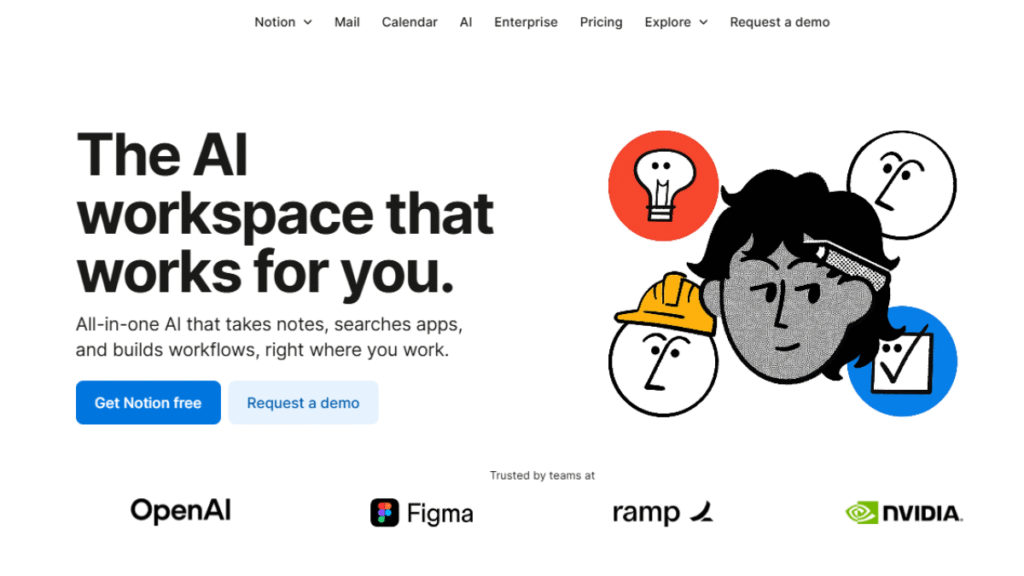
Notion AI enhances productivity by streamlining documentation, note-taking, and project management for researchers. It organizes complex research materials into structured workspaces and automates repetitive writing tasks. The platform offers smart recommendations and contextual suggestions to improve content quality. With powerful database integrations, researchers can seamlessly store articles, ideas, and summaries in one place. Its collaborative environment enables teams to brainstorm and share updates in real time. These capabilities make Notion AI especially effective for long-term research projects requiring organization and consistency. It is widely adopted by individuals and teams aiming to improve workflow clarity.
Key Features:
- Notion AI generates summaries, outlines, and polished drafts while keeping your research notes neatly organized.
- Its workspace system lets you manage databases, documents, and tasks in a single dashboard.
- Team collaboration is seamless with real-time editing, shared documents, and synced comments.
- Smart suggestions improve clarity, structure, and consistency across your research notes and writings.
4. Elicit
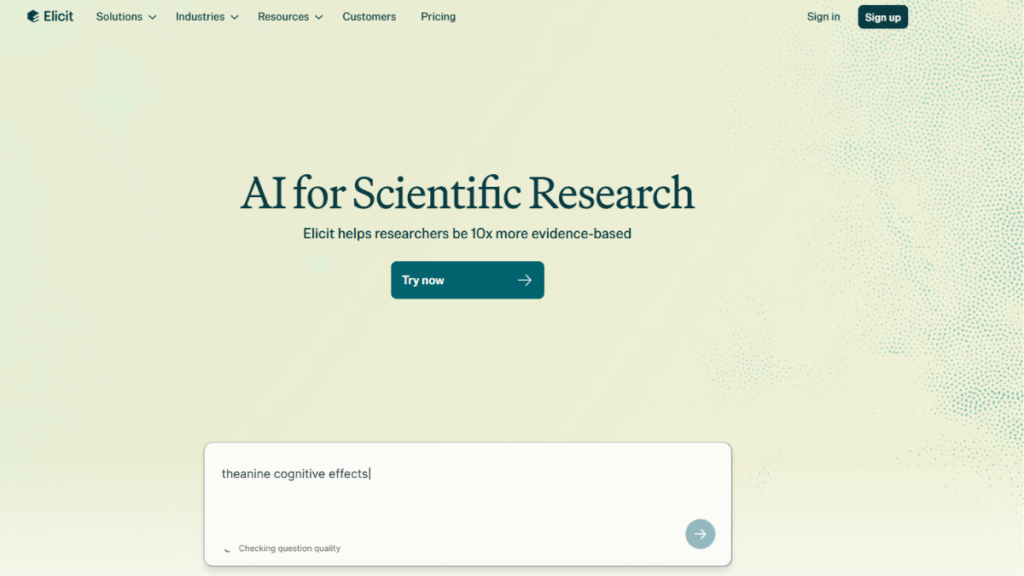
Elicit is an AI-powered tool focused on automating literature reviews by extracting insights from thousands of academic papers. Researchers can ask questions, and Elicit identifies relevant studies, summaries, datasets, and key themes. Its machine-learning models highlight essential information, saving hours of manual reading. Elicit also organizes findings in an easy-to-read table format, simplifying comparisons across sources. Designed to accelerate academic work, it supports structured review processes for students, educators, and analysts. With growing popularity among researchers, its ability to reveal hidden connections makes it one of the Best AI Tools for Research for academic discovery.
Key Features:
- Elicit automates literature reviews by pulling key findings, methodologies, and insights from thousands of academic papers.
- It displays AI-extracted findings in a comparative table, simplifying cross-paper analysis.
- Elicit highlights relevant studies that answer your research question, even when keywords are indirect.
- It maintains citation accuracy, ensuring transparency and traceability of information.
5. Perplexity AI

Perplexity AI is a research-driven chatbot designed to provide accurate answers backed by real-time citations. It sources information from trusted publications and displays references directly within responses. With conversational search, users can refine queries and explore topics in greater depth. Perplexity AI also supports document uploads, offering reliable summaries and explanations. Its precision and transparency make it a preferred tool for researchers needing verified data. The platform’s ability to browse and analyze multiple sources simultaneously enhances productivity dramatically. Its intuitive design ensures easy navigation for beginners and experts alike.
Key Features:
- Perplexity AI provides real-time, citation-backed answers sourced from trusted websites and research databases.
- It supports document uploads, summarizing PDFs and webpages with high accuracy and detail.
- The conversational search model allows users to refine queries, explore related topics, and dig deeper.
- Its minimal, intuitive interface makes navigation fast and distraction-free for researchers.
6. Genei
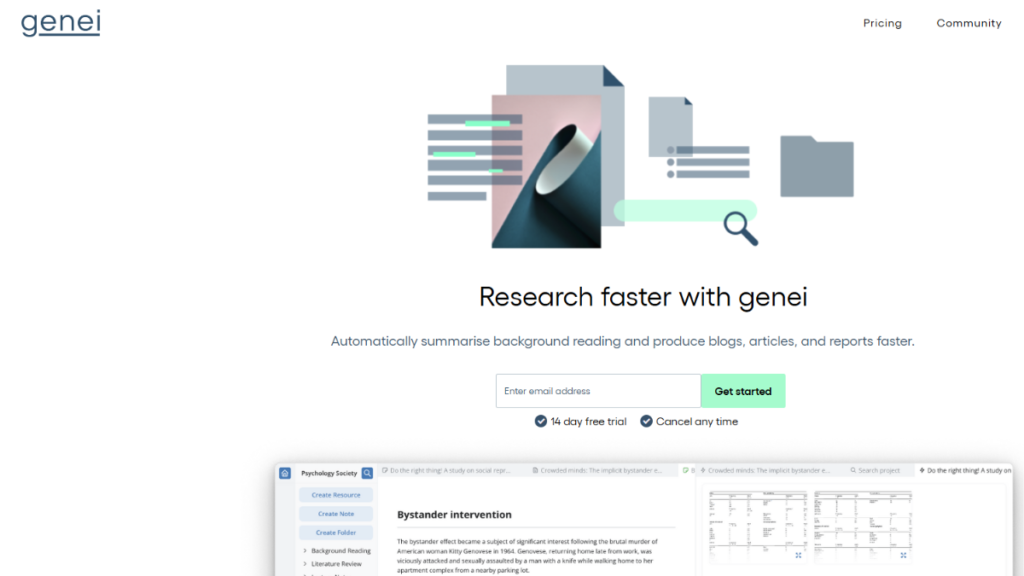
Genei is an AI platform that specializes in summarizing long documents, extracting important insights, and organizing large volumes of text. Researchers use it to process PDFs, academic articles, and multi-page documents quickly without losing essential details. Genei’s advanced algorithms highlight key arguments, data points, and conclusions, simplifying complex content. It also helps manage citations and supports note creation for better research flow. Genei is particularly useful for researchers dealing with large-scale literature reviews or multi-source projects. Its balance of speed and accuracy positions it among the Best AI Tools for Research that prioritize clarity and efficiency.
Key Features:
- Genei specializes in multi-document summarization, condensing large volumes of text while preserving core insights.
- It automatically extracts keywords and themes, helping researchers grasp major ideas quickly.
- Built-in citation assistance ensures accurate referencing and source management across documents.
- The browser extension lets users import articles instantly and generate structured summaries with one click.
How to Choose the Right AI Tool for Your Research Workflow
- Select tools that align with your research goals, whether analyzing data, summarizing sources, or managing references. Ensure the platform integrates smoothly with your existing workflow and supports long-form content processing through automation. The Best AI Tools for Research must enhance efficiency without compromising accuracy.
- Consider tools with strong collaboration features if you work in teams. Opt for platforms offering citation support, structured summaries, and reliable data handling. Evaluate usability, pricing, and compatibility with your preferred databases before final selection.
- For team-based research, prioritize tools that offer collaboration features such as shared workspaces, version tracking, and real-time editing. These capabilities streamline communication and reduce confusion in multi-author projects. A collaborative AI tool helps ensure transparency and consistency, making it easier for teams to work together effectively.
- Consider platforms that provide citation accuracy and source tracking to maintain research credibility. Tools that automatically format references or compare sources can significantly improve efficiency. Look for systems that support citation styles such as APA, MLA, or Chicago to simplify academic writing and eliminate formatting errors.
- Evaluate the tool’s user interface, learning curve, and overall usability. A complicated AI system may slow down your workflow rather than support it. Aim for intuitive platforms with clear navigation, time-saving automation, and accessible features that maximize productivity for beginners and advanced researchers alike.
- Review the pricing model and available plans before choosing a tool. Determine whether a free tier is sufficient or if premium features are necessary for your research needs. Assess data privacy policies carefully, ensuring the platform protects sensitive information and complies with institutional or professional guidelines.
Conclusion
The evolving world of research and increasing data complexity, AI tools have become vital companions for accuracy, speed, and productivity. From analyzing text-heavy documents to automating literature reviews, these tools offer precise insights that traditional methods cannot match. The Best AI Tools for Research help researchers extract information intelligently, streamline workflow, and remove the burden of performing time-consuming manual tasks. Whether you are an academic writer, student, or analyst, these modern tools reshape the research experience for better outcomes.
As you explore innovative ways to enhance your research process, integrating the best ai tool for data analysis becomes a vital step toward making informed, high-quality decisions. These tools help you navigate complex datasets more confidently, uncover trends and correlations more efficiently, and interpret results with greater clarity. AI-driven platforms also support predictive insights, enabling researchers to anticipate patterns and strengthen the reliability of their findings. With features such as automated summarization, smart citation generation, and real-time data processing, these solutions improve both the speed and accuracy of your research output. Beyond saving time, they elevate the overall experience by providing structure, reducing human error, and offering an intuitive workflow that adapts to your goals. Ultimately, integrating AI into your research process amplifies your ability to produce meaningful, well-supported, and innovative results across academic, scientific, and professional fields.